
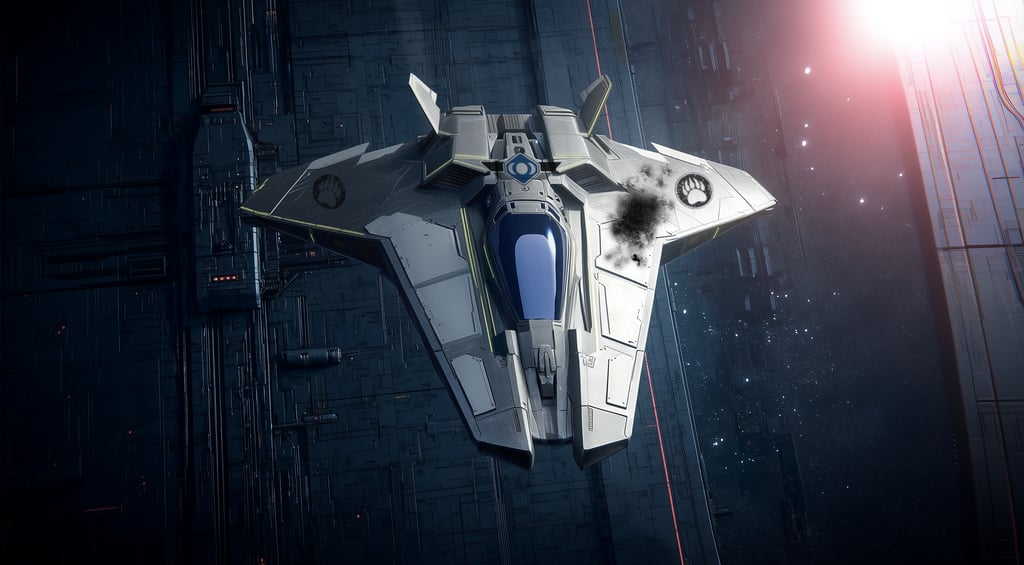
TARSAN CLAW–CLASS HEAVY FIGHTER
Assault Fighter / Linebreaker / Station Defense | Aragos Fleet
ROLE & DOCTRINE
The TARSAN CLAW is the heavy fist of the Aragos fighter corps.
It is deployed when:
Defended space must be breached
High-value assets require close escort under fire
Lighter fighters cannot survive sustained engagement.
Doctrine assumptions:
Operates in small assault elements
Often paired with FIRE CAT squadrons for cover and control
Expected to take damage, press the attack, and return scarred
The Claw does not outfly its enemies. It outlasts them.
PROPULSION
Micro-Singularity Core (“The Talon”)
Class: Heavy Fighter Micro Well
Output: Very high, tightly governed
Bias: Strong forward fall with aggressive damping
The Claw’s singularity is tuned for authority, not twitch speed. Acceleration is deliberate and crushing, allowing the pilot to commit fully to attack runs without destabilizing the frame.
This ship moves like something with weight behind its intent.
Vector Field Drive Array
Reinforced, low-agility configuration
optimized for:
Stable head-on approaches
Recoil compensation from heavy weapons
Controlled yaw under sustained fire
The Claw does not evade elegantly. It holds its line.
Conventional Thrusters
Oversized impulse engines with high torque.
Used for:
Attack initiation
Brute-force repositioning
Emergency withdrawal with battle damage
Slower response than lighter fighters, vastly more force.
When these thrusters light, the fight is already serious.
POWER
Energy Architecture
Primary Gel Pack Trio: Weapons-priority routing
Secondary Packs: Shields and propulsion
Emergency Cell: Cockpit, life support, egress systems
Operational Reality
Can sustain heavy weapon discharge longer than any other fighter
Heat dissipation, not energy supply, is the limiting factor
Systems degrade under damage rather than catastrophically failing
The Claw stays dangerous until it physically cannot.
DEFENSE
Signature Management
Minimal masking
High emissions accepted as doctrinal reality
Hull geometry emphasizes intimidation and durability
Stealth is irrelevant when the mission is dominance.
Field Shielding
Heavy Fighter Vector Shield
Strong frontal and ventral bias
Designed to:
absorb opening volleys
withstand station-side defenses
protect during disengagement.
Slow recharge, high endurance. You do not dodge fire in a Claw. You take it and keep coming.
Armor & Structure
Heavy composite armor plating
Reinforced cockpit capsule and engine housings
Redundant control pathways and damage isolation
The Claw is built to come back damaged — and fly again.
ARMAMENT
Primary Weapons
Heavy Kinetic Cannons
Hull-cracking, short-range dominance
Optimized for stations, corvettes, and hardened targets.
Devastating during attack runs
These weapons exist to end resistance, not discourage it.
Secondary Weapons
High-Energy Pulse Cannons
Shield overload
area suppression
Missile Hardpoints
Anti-ship and bunker-buster payloads
limited count, decisive use
Optional Systems
Advanced target-painting for fleet fire
Boarding suppression pods
Reinforced prow structure for last-resort ramming doctrine
Ramming is doctrinally acknowledged. Pilots are strongly discouraged—but trained.
PILOT ARCHITECTURE & TARSAN PHYSIOLOGY (CORE DESIGN)
The TARSAN CLAW is engineered around Tarsan physiology, not merely adapted for it.
Tarsan pilots are broader, denser, and more powerfully built than most Aragos species.
Cockpit & Internal Layout
Enlarged pilot capsule with increased shoulder and torso clearance
Reinforced seat cradle rated for higher mass and inertia
Extended legwell depth for heavy lower limbs
Structural tolerances assume greater pilot weight and force input
The pilot is not confined. They are anchored.
Control Geometry
Wider control spacing for larger hands
Actuators designed for forceful, decisive input
Physical controls retained alongside assisted systems
Inertial & G-Load Management
Inertia dampening is biased toward the spine, neck, and shoulders
G-load tolerances exceed standard fighter limits
Cockpit field geometry assumes higher sustained tolerance
Tarsan pilots can push longer and harder. The Claw lets them.
Life Support & Ergonomics
Atmosphere mix adjustable for higher oxygen demand
Thermal regulation tuned for dense musculature heat output
Suit and armor interfaces positioned for bulkier pilot gear
OPERATIONAL CONSEQUENCES
TARSAN CLAW cockpits are inefficient or uncomfortable for smaller pilots
Non-Tarsan pilots can fly the Claw only in emergency conditions
Tarsan pilots in lighter fighters often feel under-supported by comparison
The ship and the pilot are meant to match.
OPERATIONS
Crew
single pilot
typically assault-qualified or senior fighter personnel
Endurance
short-to-medium sorties
optimized for intense, high-risk engagements
Deployment
Guardian Point defense wings
ARGAGNAM-class cruisers
assault task groups
When Claws launch, lighter craft clear space.
IN-WORLD DESIGN MAXIM (CANON)
"The Claw was not built to fit everyone. It was built to let Tarsans bring all of themselves into the fight.”
CANON LOCK
Heavy assault fighter
Tarsan-scaled cockpit and systems by design
High-durability, weapons-forward doctrine
Completes the Aragos fighter triad with FIRE CAT and NIIR